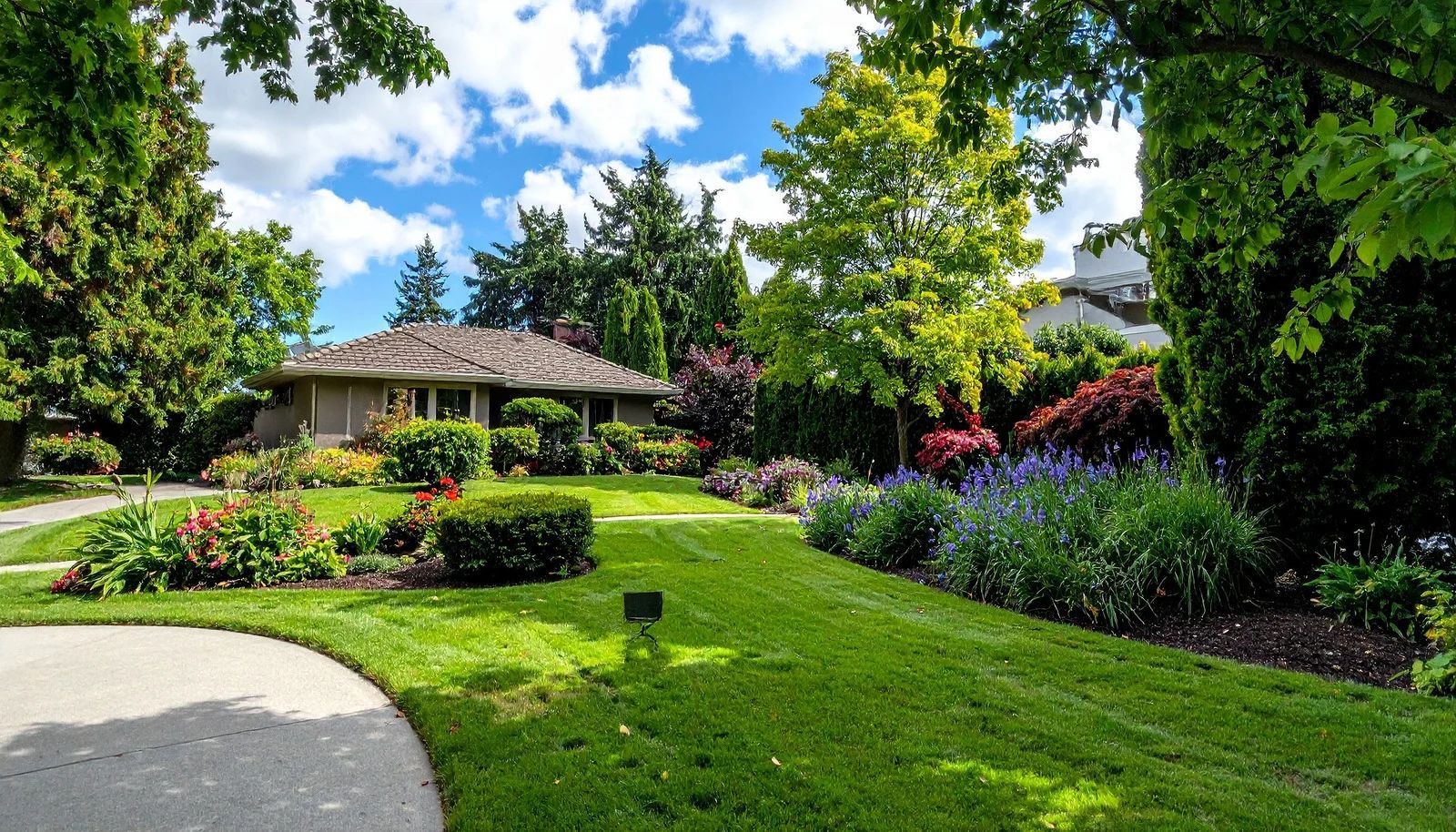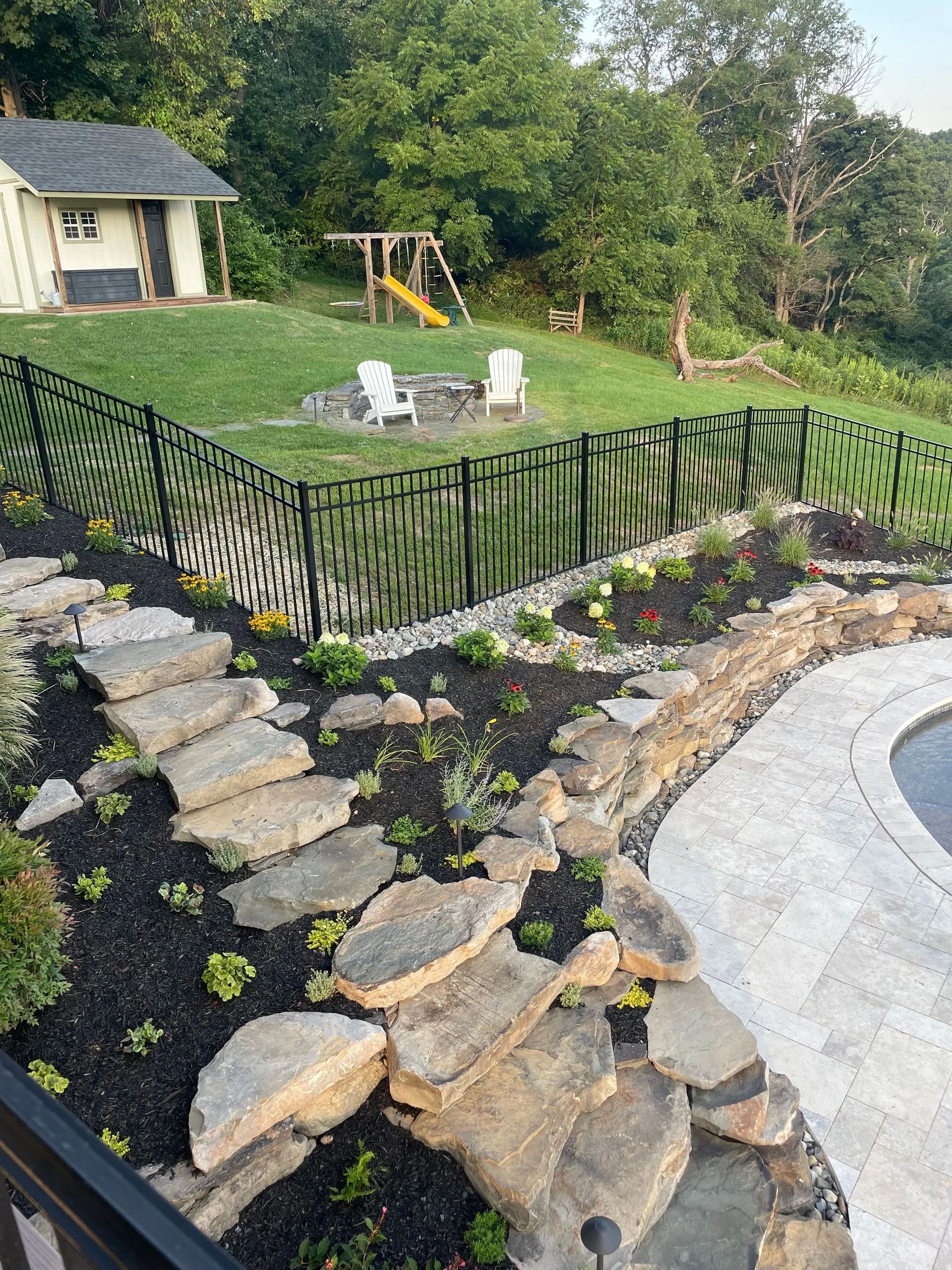
What a Four-Season Landscape Design Looks Like After the Flowers Are Gone
September 14, 2026
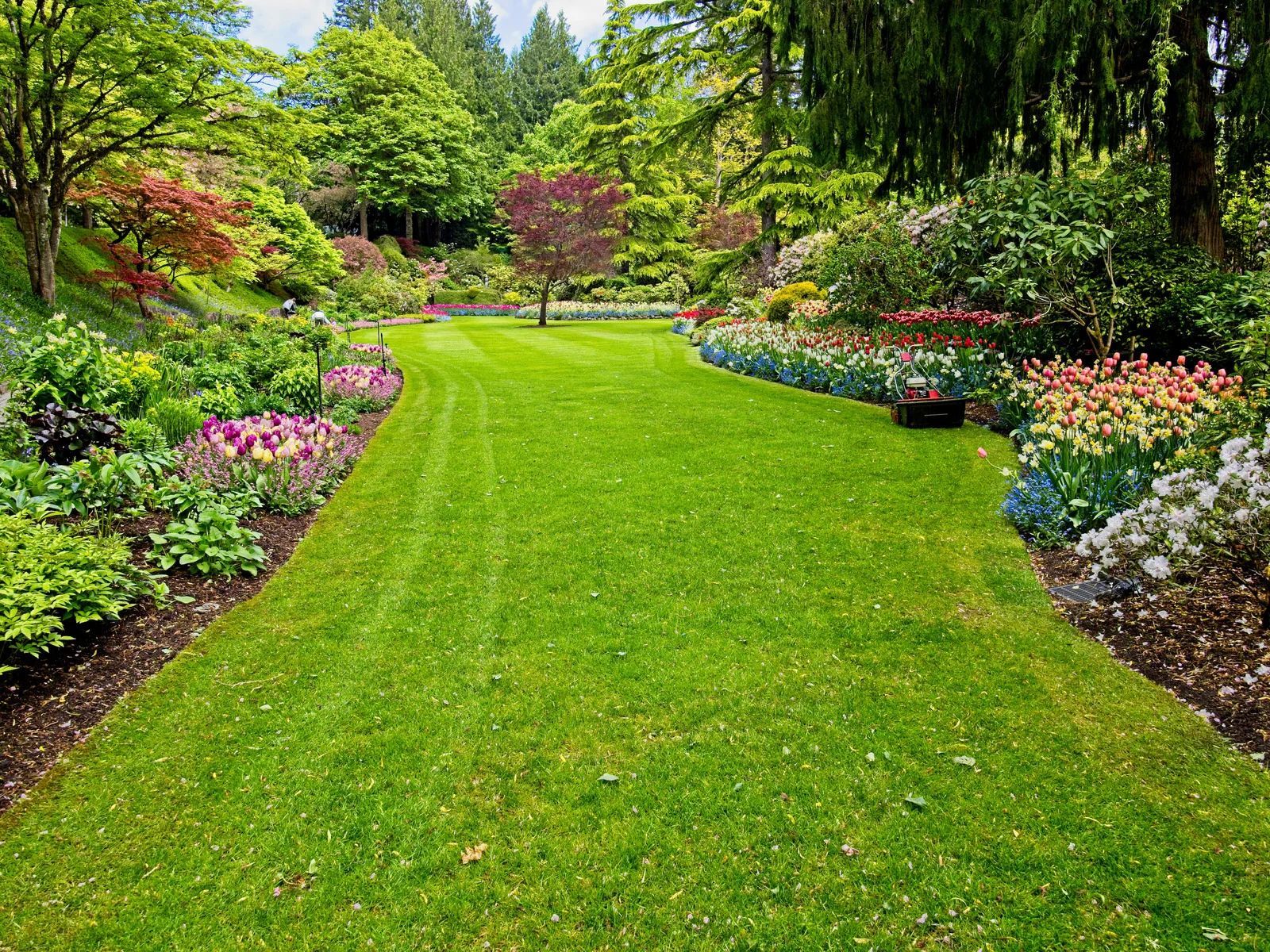
QUICK ANSWER: A four-season landscape design leans on structure rather than bloom. Evergreens, layered heights, textured bark, and hardscape carry the visual weight once perennials go dormant, while a planned bloom succession keeps color moving from March through October. In Maryland's climate, that structure also has to hold up to clay soil and heavy deer pressure, which narrows the plant list but doesn't shrink the design. The strongest yards read as intentional in every season because each plant is doing a specific job — not just filling a bed until it flowers.
Drive through White Hall or Monkton in late January and you'll see the split immediately. One yard is a flat expanse of brown turf and bare stems, nothing standing between the house and the road but memory of what bloomed there in June. Next door, a hedge of dark evergreen holds its shape against the gray sky, red-stemmed dogwood catches the low sun, and a stand of switchgrass still holds its seed heads, moving slightly in the wind. Both yards were probably planted with the same enthusiasm in spring. Only one was planted with winter in mind.
That gap is the whole idea behind four-season landscape design. It isn't a style — it's a sequencing problem. Every plant has a season when it peaks and a season when it disappears, and the job of a designer is to make sure something is always covering for whatever just went dormant. Get the sequencing wrong and a yard looks great for eight weeks and forgettable the other forty-four. Get it right and there's always something to look at from the kitchen window.
Winter Is Where the Design Actually Gets Tested
Spring and summer forgive almost any planting plan. Flowers are loud enough to hide a weak layout. Winter doesn't offer that cover. Once the perennials die back and the deciduous trees drop their leaves, whatever framework exists underneath — or doesn't — becomes the whole picture.
That's why evergreens do more design work than any other plant category, even though they get the least attention when a homeowner is choosing what to plant.
Backbone Plants
Eastern redcedar and American holly are two natives that hold their form and color through a Maryland winter without complaint, giving a bed a fixed point that the eye can rest on once everything else has gone quiet.
Placement Matters More Than Variety
A single well-placed evergreen anchoring the corner of a bed does more for winter structure than five scattered ones — clustering reads as intentional, scattering reads as leftover.
Here's something most people don't think about until they see it happen: deer pressure changes what "evergreen" actually means on a property near the Hereford zone or out toward Jarrettsville. An eastern redcedar left unprotected through a hard winter can end up with a stripped lower third, browsed clean up to the height a deer can reach while standing. The plant survives, but the silhouette it was supposed to provide gets erased right where it matters most.
Layering Height So Nothing Reads as Empty
A yard with only foundation shrubs and lawn will always look thin in winter, no matter how healthy those shrubs are. Structure comes from layering — a tall element, a mid-height element, and something low that ties the ground plane together. Skip a layer and the eye notices the gap even if it can't name it.
Think of it the way a stage set works. The tall layer — trees and large shrubs — is the backdrop. The mid layer, usually shrubs in the three-to-six-foot range, is where most of the seasonal change happens: flowering, fruiting, color shift. The ground layer, whether it's a spreading perennial, an evergreen fern, or a low grass, is what keeps the bed from looking like isolated plants sitting in mulch. Maryland's clay soil pushes this layering decision in a specific direction, too. Clay holds water through the winter and can starve roots of oxygen in a wet spell, so a lot of the workhorse mid-layer shrubs that tolerate compacted, poorly drained clay — summersweet and blackhaw viburnum among them — end up doing double duty as both the seasonal color layer and the layer that can actually survive the soil they're planted in.
Christmas fern, a native evergreen fern that holds its fronds through winter, is one of the few ground-layer plants that solves two problems at once in a shaded Maryland bed: it fills the low layer year-round, and it's one of the plants deer tend to leave alone even when other food is scarce.
Choosing a Bloom Succession Instead of One Big Show
Once structure is in place, the planting plan needs a calendar, not just a plant list. Early spring bulbs and hellebores open the season before most trees have leafed out. Flowering shrubs and long-blooming perennials carry summer. Asters, goldenrod, and ornamental grasses take over as the days shorten in September and October. Then bark, berries, and seed heads finish the year once bloom is done entirely.
The mistake a lot of yards make is loading up on plants that all peak in the same six-week window — usually late May through June — and leaving the other ten months thin. A better plan spaces peak bloom times out so there's rarely more than a few weeks where nothing in the bed is doing something.
TIP: Walk your own property in each season before finalizing a planting plan, not just in spring when everything looks tempting at the nursery. A bed that looks full in May can look completely bare in December, and you won't catch that gap unless you've actually stood there in December and looked.
Bark, Berries, and Seed Heads Carry the Yard When Flowers Are Done
Winter interest isn't really about flowers at all — most of the plants that make a January landscape worth looking at aren't blooming anything. Red chokeberry holds clusters of bright red fruit well into winter, often past the point when birds have cleared everything else. Paperbark maple and river birch show off peeling, colorful bark once their leaves are gone, texture that's invisible all summer and suddenly the whole point in February. Ornamental grasses like switchgrass and little bluestem turn a warm tan or copper color in fall and hold their upright form through most of the winter instead of collapsing, catching frost and low light in a way no flower can.
Leaving seed heads standing on coneflower and other late-season perennials rather than cutting them back in October does two things at once: it gives the bed texture through the coldest months, and it feeds birds when almost nothing else is available. It's a small decision that a lot of otherwise well-planned yards get wrong simply out of habit — the instinct to tidy everything up before winter works against the four-season goal.
Deer Pressure and Clay Soil Decide What Actually Survives Here
Anywhere north and east of Baltimore — White Hall, Parkton, Freeland, Jacksonville — deer pressure is heavy enough that plant selection has to account for it from the start, not as an afterthought once something's been chewed to the ground. The University of Maryland Extension's own guidance on this is blunt: there's no such thing as a deer-proof plant, only plants deer usually pass over when better food is available. Spicebush, sweetbay magnolia, summersweet, and the switchgrass and little bluestem already mentioned for winter texture all show up on that usually-skipped list, along with blackhaw viburnum, which adds white spring flowers and dark fall fruit on top of being one of the more reliable choices near wooded lot lines..
WARNING: Deer-resistant lists shift based on what else is available for deer to eat that season, so a plant your neighbor never has trouble with can still get hit hard during a lean winter or a drought year when their usual food sources dry up. Treat any deer-resistant plant list as a strong starting point, not a guarantee, and be ready to protect young plantings through their first couple of winters while they establish.
How We Build a Planting Plan Around All Four Seasons
In our own design work, a four-season plan doesn't get bolted onto a design after the hardscape is drawn — it's part of the same site walk where we're looking at drainage, sun exposure, and how the clay on a given lot has been graded over the years. We map out where evergreen structure needs to anchor a view before we ever choose a flowering shrub, because the framework has to hold up before the color gets layered in on top of it.
Because our team handles design and installation as one continuous process rather than handing a plan off to a separate contractor, the planting sequence and the hardscape schedule stay coordinated — patios, walkways, and retaining walls get built with the mature size and root spread of nearby plantings already factored in, not guessed at later. That coordination is also where hardscape earns its keep in a four-season plan: unlike a perennial bed, a stone patio or a well-built retaining wall looks the same in January as it does in July, giving a landscape a fixed, reliable anchor that the seasonal planting can play off of. We've spent enough seasons watching how properties across White Hall, Cockeysville, and the Hunt Valley area weather a Maryland winter to know which combinations of structure, layering, and plant selection actually hold up here, rather than just looking right on paper.
Frequently Asked Questions
What plants give the most winter interest in a Maryland landscape?
Evergreens carry the base structure, while paperbark maple, river birch, red chokeberry, and switchgrass add colorful bark, persistent berries, or seed heads once bloom fades. American holly and eastern redcedar keep the green going year-round.
How many evergreens does a four-season design actually need?
There's no fixed ratio, but a common approach keeps roughly a third of a bed's woody plants evergreen, clustered at corners and focal points instead of scattered, aiming for a recognizable shape, not full coverage.
Can a four-season landscape still hold up with heavy deer pressure nearby?
Yes, though deer pressure narrows the plant palette and changes how young plantings get protected early on. Natives like spicebush, summersweet, blackhaw viburnum, and switchgrass tend to get passed over more often than showier ornamentals.
Does Maryland's clay soil limit which plants work for year-round structure?
Clay shapes the plant choices more than it limits them. It holds moisture and drains slowly, but summersweet and blackhaw viburnum tolerate compacted, wetter soil well. Grading and amending the bed before planting matters more.
When is the right time to plant for four-season structure?
Fall and early spring both work well for most trees and shrubs, since cooler weather stresses new roots less than summer heat. Sequencing matters more than exact date, with structural evergreens and hardscape going first.
Do ornamental grasses actually hold up through a Maryland winter?
Most upright grasses like switchgrass and little bluestem stay standing through snow and wind better than expected, collapsing only under heavy snow. Their value is texture and motion, and cutting them back late preserves structure.
The Real Payoff of Planning for Every Season
Four-season design isn't really about finding perfect plants; it's about accepting that no single season carries a landscape on its own. Structure holds the framework, bloom succession keeps color moving, and texture from bark, berries, and seed heads fills the gaps once flowers fade. Maryland's clay soil and deer pressure narrow the plant list, but they don't narrow the ambition behind it. A yard planned this way stops depending on one good month and starts working for all twelve, quietly, without needing anyone to notice the effort.
Balco Landscapes
has spent 30
years watching how properties across White Hall, Columbia, and the surrounding Maryland region hold up through every season, not just the ones that photograph well. That experience shapes how structure, bloom timing, and plant selection come together on each site, long before the first shovel goes into the clay. A
landscape
built this way keeps offering something worth noticing, whether it's the middle of June or the dead of January.